Batemans Bay, NSW – 2002
“Keeping the Adventure in the Race” was what race organiser Craig Bycroft promised — and delivered — with many competitors proclaiming the inaugural Mountain Designs GeoQuest Adventure Race one of the best and worst weekends of their lives.
“Definitely the most incredible weekend of my life — and believe me, I’ve had loads of great weekends,” said one competitor.
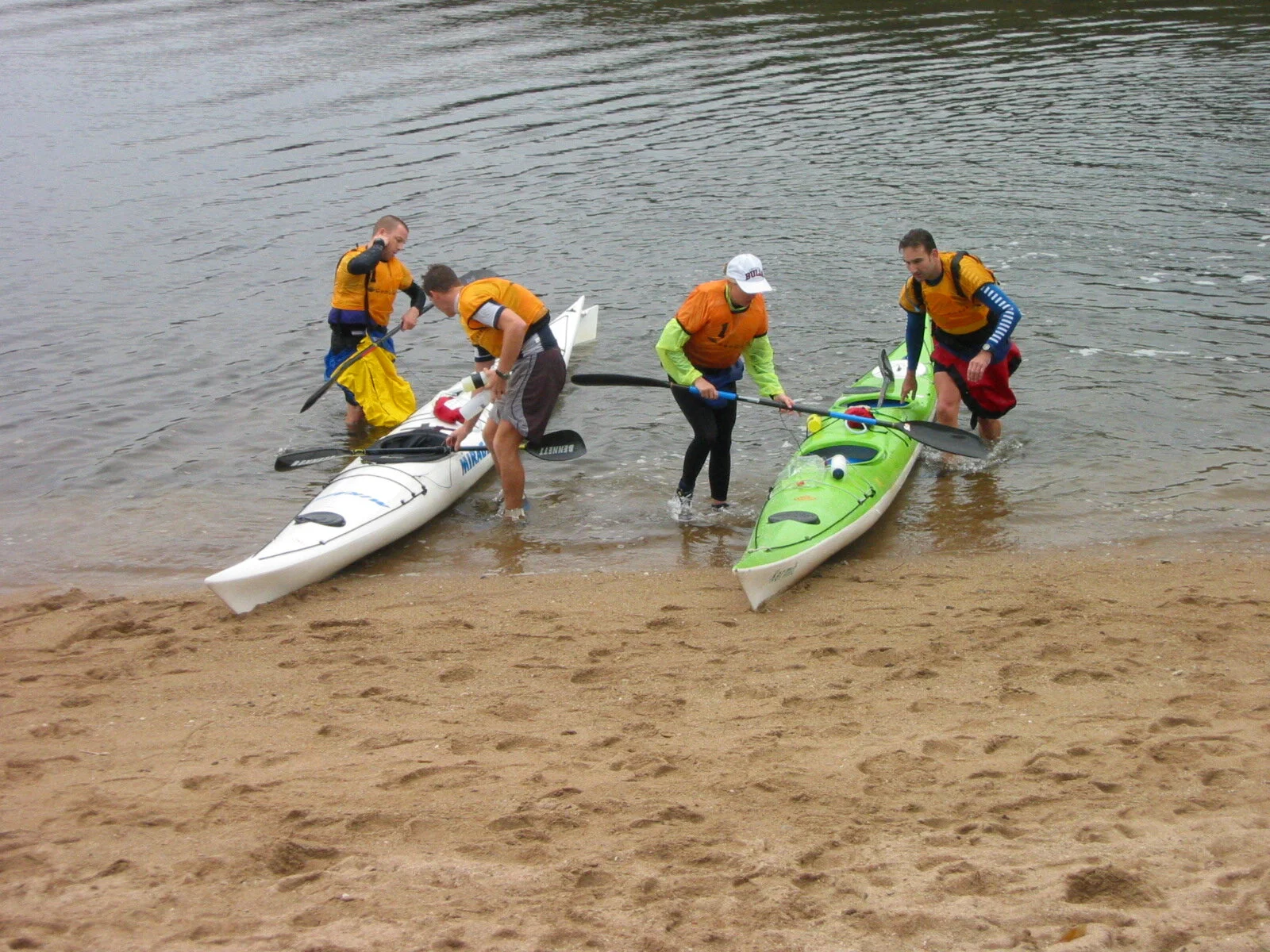
Seventy competitors lined up on a beach on the South Coast of NSW in the early hours of 8 June 2002, sea kayaks at the ready, to begin a 48-hour adventure race.
As a testament to the nature of the race, only 12 would eventually cross the finish line.
Teams headed out on a course that would see them sea kayaking, trekking, mountain biking and roping their way across some serious country. Cross-country navigation and the occasional mental exercise were all part of the game.
The course consisted of four distinct legs.
The opening leg saw teams sea kayak 30 kilometres through spectacular coastal scenery, accompanied at times by curious dolphins. Bemused local fishermen looked on, struggling to comprehend that these teams planned to race continuously for 48 hours.
“But what about sleep?”
“Continuous physical exertion for 48 hours at 80% capacity — that’s more than what most people do in a year.” — Unknown competitor
The Mexicans and Mountain Designs completed the opening paddle strongly in around three hours. A mad scramble out of the boats and through transition saw teams jump on their bikes and head towards the start of a foot rogaine.
Teams dispersed into the bush and began emerging again with full check cards around 10 hours later.
The leg forced competitors to make constant navigational decisions: take the longer but faster fire roads to a checkpoint, or trust their navigation and attempt a shorter cross-country route.
The Mexicans arrived at the start of leg three first at 21:21, 14 hours into the race, holding a three-hour lead over Latrobe Valley Tri Club.
Many teams further back chose to take a break from the relentless navigation and terrain, putting up tents and waiting for daylight before collecting their remaining checkpoints. This resulted in a flood of teams returning from the leg between 5:30am and 10:30am — around 24 hours into the race.
To begin leg three, teams first crossed a waist-deep creek carrying their bikes and roping equipment above their heads.
Once on the other side, they began pedalling approximately 60 kilometres north towards the aptly named Castle.
From there, teams trekked towards the summit, gaining around 500 metres of elevation and at times donning harnesses to negotiate steep, rocky sections of the route.
At the top they were greeted by a multi-pitch abseil. It dramatically shortened the return journey, but after more than a day of racing it still required plenty of courage to step over the edge.
While the leaders tackled the Castle, teams further back were still fighting their way through the hills on the bike.
Competitors began to withdraw for reasons ranging from injury and team disagreements to simple exhaustion. As darkness fell around 36 hours into the race, the prospect of another full night outside — combined with the likelihood of missing the leg-three cut-off — saw more teams make the difficult decision to stop.
Thirty-nine hours into the race, only eight of the original 17 teams remained on course.
The leading teams had by then descended from the Castle and ridden another 45 kilometres across more forgiving terrain to the end of leg three. A late course reroute meant the planned kayak section was removed.
The Mexicans completed the leg at 18:00, 35 hours into the race.
Latrobe Valley Tri Club arrived next at 22:14, followed by Team Mille at 22:58. Team Two Inspire / Salomon reached transition at 23:50, 41 hours into the race, before making the difficult decision to withdraw due to injury.
Desperately tired and gulping coffee, bleary-eyed competitors extracted themselves from transition and set off across the river for the final leg: a 40-kilometre bike rogaine over moderate terrain.
Just before midnight, The Mexicans gathered on the far side of the river and prepared to row across to the finish line.
Coordinating wooden oars after more than 40 hours of racing proved to be one final challenge. There were a few circles and hesitant strokes before they found their rhythm and made their way towards the finish.
“After all we had done together, that row was nearly the undoing of our team!” said one member of The Mexicans.
They crossed the line 41 hours into the race looking remarkably calm, collected and even clean.
Pizza and beer supplied by their support crew followed, along with questions and photos, before the team finally headed off for some well-earned sleep.
Through the remainder of the night, several more teams emerged from leg three. Unfortunately, the cut-off meant they could not continue onto the final leg, but their achievements remained extraordinary — around 45 hours of continuous racing across a demanding course.
At almost exactly 48 hours, Team Mille appeared on the opposite side of the river, only five minutes ahead of Latrobe Valley Tri Club.
Race rules gave Mille first preference to the boats. Ten minutes later they crossed the river to finish second.
Latrobe Valley Tri Club followed around 20 minutes later to take third.
And with that, the inaugural Mountain Designs GeoQuest came to an end.
At the presentation, winning teams and those recognised for outstanding performances shared more than $9,000 in prizes generously provided by Mountain Designs and Cheeky Monkey.
As competitors mingled around race headquarters before returning to their normal lives, some offered advice, some sought it, and plenty swapped stories about who had done it harder.
Most were already talking about what they had learned — and what they would do differently when they returned the following year.
One comment from a member of Team Made in NZ perhaps captured the inaugural GeoQuest best:
“Those of the 2002 GeoQuest who go on to compete in future GeoQuests will look back and realise that we took part in something quite special with a small group of like-minded weirdos.
“Whilst the number of entrants will no doubt increase, I can only hope that the level of challenge remains.
“The most intriguing facet of this race that remains with me is not so much that ‘I did not finish’ as that ‘I could not finish’.
“This means that I pushed myself until I could not go on. And for that revelation I thank you all very much.”